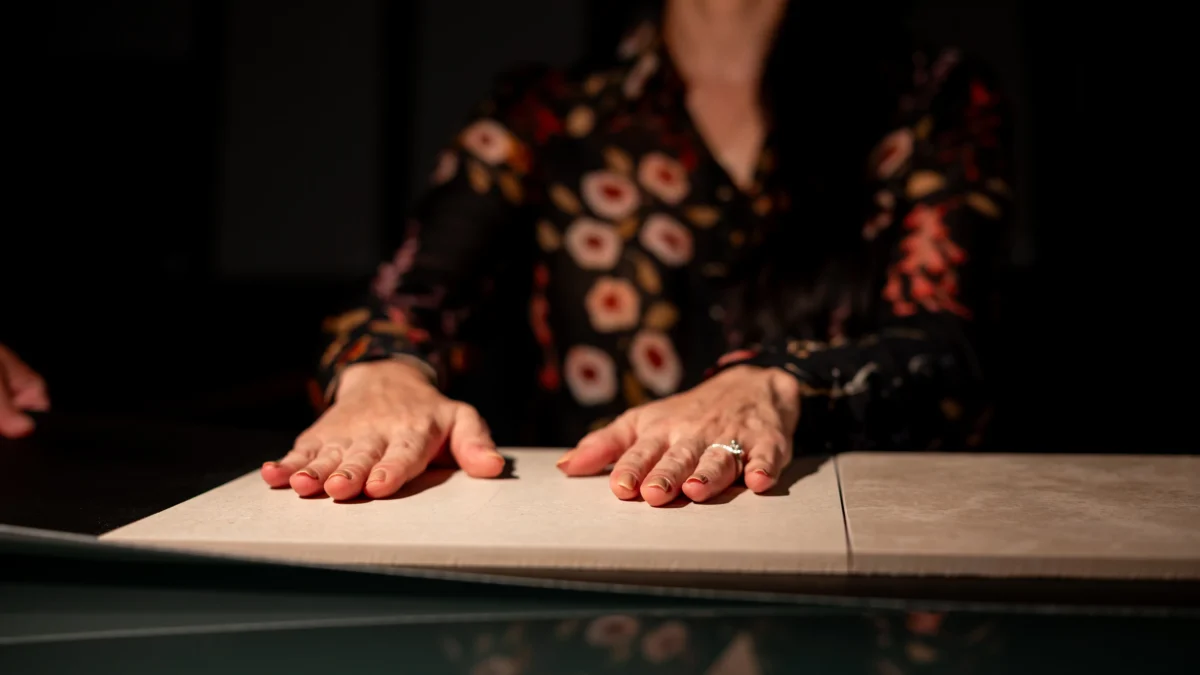
During the inauguration of Altadia’s Global Innovation Hub in Sassuolo, we used a wearable EEG to measure the brain’s response to contact with three ceramic surfaces made with Altadia materials. Compared to rest, touching the surfaces increased the brain engagement index by an average of 4.5%, with an increase in 60% of participants. The figure matters because of the audience on which it was recorded: customers and partners from the industry who are used to touching ceramics every day. The article explains how touch works, how attention is measured outside the laboratory, and what the result means for a company that develops materials.
Key takeaways
- Contact with Altadia ceramic surfaces increased the brain engagement index by an average of 4.5% compared to rest, in an audience of ceramics industry professionals.
- The increase was observed in 60% of participants, and for 40% it exceeded 5% relative to their own resting level.
- The result holds up across several independent analyses, including when the sample is restricted to the recordings with the best signal.
- A brain that activates on contact indicates that the material enters the field of attention, a step that precedes any preference or purchasing decision.
- Touching with the palm mainly engages the kind of touch that recognises materials, whereas measuring liking requires contact on areas rich in C-tactile fibres, such as the forearm.
In the tactile neuromarketing study conducted for Altadia, when participants placed their hands on the ceramic surfaces, the engagement index recorded by their brains rose by an average of 4.5% compared to the resting state. The increase was observed in 60% of the people involved, and for 40% it exceeded 5%. The figure carries particular weight given the audience on which it was measured. These were customers and partners from the ceramics industry, people who handle slabs, samples and finishes every day as part of their work. Even for them, contact with those materials produced a measurable response, and for a company that develops surfaces, this means knowing that its product does not go unnoticed even in front of those who know it better than anyone else.
The study took place on 29 September 2026, during the inauguration of the Global Innovation Hub that Altadia opened in the Sassuolo ceramic district, a centre dedicated to experimenting with new technologies and solutions for the global ceramics market, aimed at customers and partners. Among the evening’s activities, one moment was dedicated to our tactile neuromarketing experience. In this article, we explain what we measured, how we measured it, and what the result tells a company that produces materials.

Why the result matters
The brain receives far more sensory information at any given moment than it can process, which is why it filters. The clothes on our skin, the chair beneath us, the ring on our finger stop being perceived just moments after contact. The same mechanism, habituation, progressively reduces the response to stimuli that repeat unchanged over time and bring no new information.
For those who work in the ceramics industry, touching a surface is an everyday, almost automatic gesture. It was entirely plausible that contact with the slabs would slip by as background noise, leaving no trace in brain activity. This was precisely the stated aim of the study. Altadia wanted to find out whether its surfaces activate the brain of those who touch them, regardless of whether they like them or not. The data gave a clear answer.
A brain that activates on contact does not mean the person will buy the product. Purchasing decisions are influenced by price, personal taste, context and many other factors. It does mean, however, that the material has entered the field of attention and that the brain is taking it into consideration. Perhaps the colour doesn’t convince, perhaps the finish does, but the surface has become an object of evaluation. It is the step that comes before any preference, and also the first one a material must pass to stand a chance on the market.
The Altadia surfaces used in the study
Altadia produces frits, glazes, colours and inks for the ceramic tile industry, in other words the materials that determine the appearance and surface of a finished slab. The surfaces touched by the participants were made with Altadia-produced materials, and there were three of them, differing in roughness and texture: one smooth, one intermediate and one rough.
The choice of three such distinct finishes had a precise purpose: placing a range of tactile sensations under the participants’ hands, from the smoothest surface to the most textured, made it possible to observe the brain’s response to the experience of the material as a whole. The result shows that this experience, with the material as it had been worked, succeeded in capturing the attention of an audience that knows ceramic surfaces by trade.
Tactile neuromarketing: what happens in the brain when the hand touches a surface

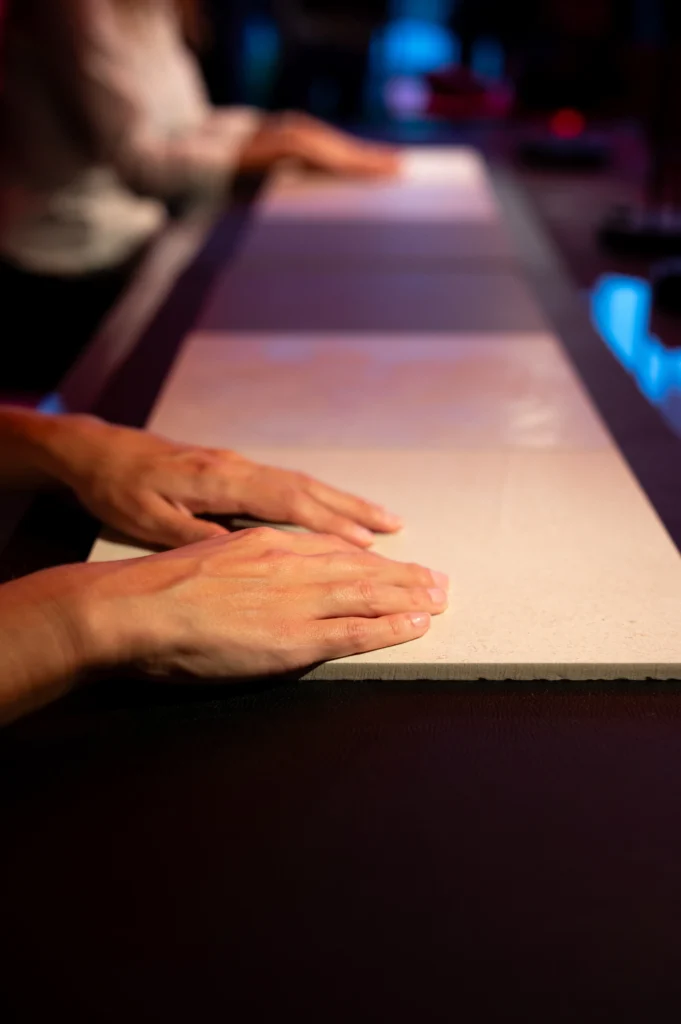
The skin of the hand, particularly that of the fingertips, is among the areas of the body richest in mechanoreceptors, the receptors that convert pressure and vibration into nerve signals. Some respond to fine details, others to the vibrations produced when the skin slides across a surface. The sensation of smoothness or roughness arises from the combination of this information, which travels up to the somatosensory cortex, the area of the brain in which every part of the body has its own representation. From there, the signal continues towards the regions that integrate it with attention and the evaluation of the stimulus.
Discriminative touch and affective touch
Neuroscience distinguishes two components of touch. Discriminative touch is used to recognise what is being touched, meaning shape, consistency and roughness, and travels along very fast nerve fibres. Affective touch concerns the pleasant quality of contact and runs through a family of slower fibres, called C-tactile fibres.
The link between these fibres and pleasantness was documented in the study published in Nature Neuroscience in 2009 by Håkan Olausson’s group, which directly recorded their activity while the skin was stroked with a soft brush. The fibres responded most strongly at precisely the stroking speeds that participants rated as most pleasant. C-tactile fibres are found mainly in hairy skin, such as that of the forearm and the back of the hand, and are scarce in the palm. Touching with the palm therefore mainly engages the kind of touch that recognises materials, a detail that guided both the design of the study and the interpretation of the results.
How engagement is measured with a portable EEG
Electroencephalography records, from the surface of the head, the electrical activity produced by large groups of neurons working in synchrony. The signal is extremely weak but very fast, and makes it possible to follow changes in brain state while a person lives through an experience, second by second.
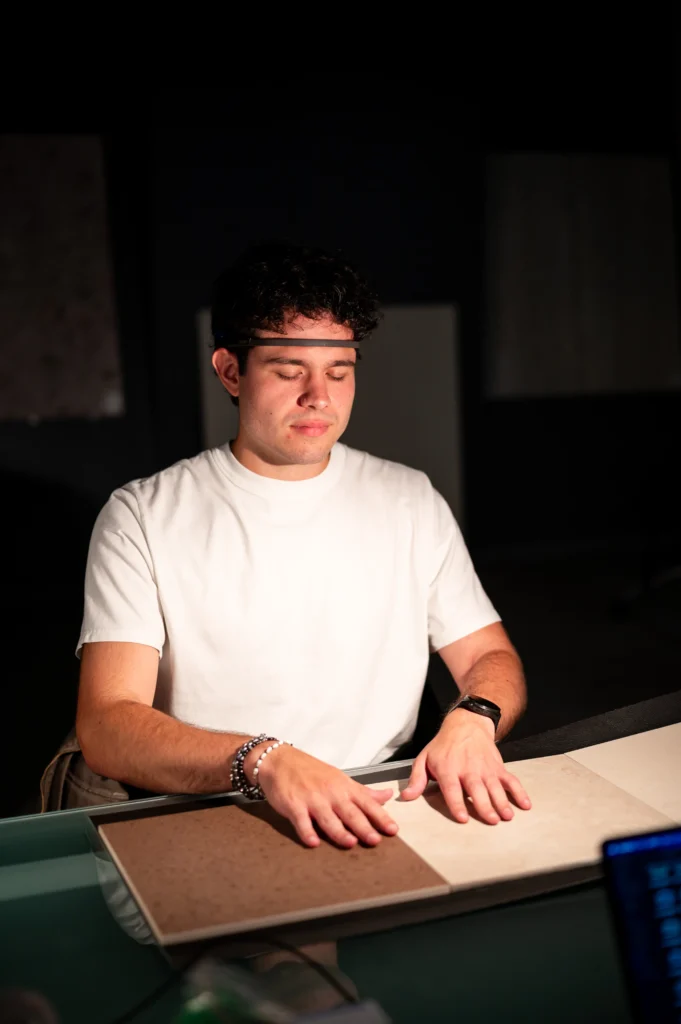
For the study we used the Muse 2, a wearable headband with four dry sensors, two on the forehead (at the positions known as AF7 and AF8) and two above the ears (TP9 and TP10). It requires no conductive gel or skin preparation, can be put on in a few seconds, and has been the subject of validation studies for exactly the type of measurements we were interested in. Anyone who wants to know more about the device will find the details in our guide to the EEG sensor we use in our experiences.
The brain rhythms of attention
The EEG signal contains different rhythms: some increase when the brain is attentive and alert, while others dominate in states of relaxation. From the balance between these rhythms, an engagement index is derived, which rises when the person devotes more attention to the stimulus. The approach has solid roots; one of the classic references comes from NASA Langley Research Center, where in the mid-1990s Alan Pope and colleagues studied how to track the engagement level of pilots dealing with automated tasks, in a paper published in Biological Psychology that remains a starting point for attention studies to this day.I
The direction of the response in tactile neuromarketing
As a secondary measure, we also recorded the direction of the response, that is, whether the brain tends to approach the stimulus or withdraw from it. It is derived from the difference in activity between the left and right sides of the forehead, and is the most widely used measure for implicitly estimating liking.
Each person compared with themselves
The absolute value of brain activity varies greatly from person to person, for reasons that have nothing to do with the stimulus. For this reason, each participant was compared with themselves, by measuring the difference between a moment of rest and the moment of contact. The rest phase becomes the personal reference point, and the change relative to that reference isolates the effect of the surfaces.
Tactile neuromarketing: the protocol used at the event
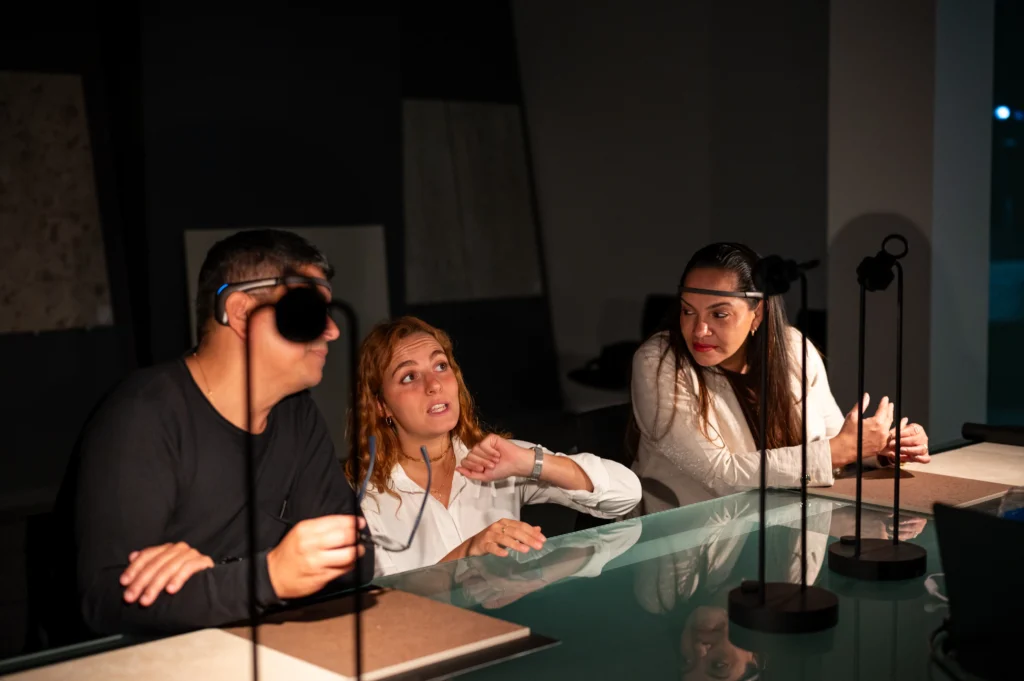
The study involved 67 participants, and each session lasted about one minute, entirely with eyes closed. For the first 30 seconds, the participant held their hands suspended above the surfaces without touching them. For the following 30 seconds, they rested their palms while the operators slid the three finishes under their hands, one after the other. Keeping the eyes closed in both phases has a precise technical reason. Closing the eyes in itself alters brain activity, so keeping this condition constant ensures that the difference between rest and contact depends on touch rather than sight.
The contact was passive, meaning the surfaces were moved by the operators while the participant stayed still, because hand and arm movement is the primary source of interference in an EEG recording, especially with a wearable device. The movement detected during the sessions proved negligible.
The choice of the palm was also deliberate. Those who evaluate materials professionally do so with their hands, and asking people to touch the ceramics with their forearm would have been an unnatural gesture, more suited to a laboratory than an event. The palm ensured a spontaneous experience and steered the study towards measuring engagement rather than liking. The finishes always passed in the same order, so the result concerns the tactile experience as a whole rather than any individual surface.
The criteria for accepting or discarding a session were set before looking at the results, so that the selection could not favour one outcome over another. Sessions in which the signal did not reach sufficient quality were excluded from the analysis.
Altadia surfaces do not go unnoticed
During contact with the surfaces, the engagement index increased by an average of 4.5% compared to rest. Looking at individual participants, 60% showed an increase, and 40% recorded an increase of more than 5% relative to their own resting level. The effect therefore concerns the majority of people and does not depend on a few isolated reactions.
The result was verified through several independent analyses, including restricting the sample to the recordings with the best signal, and the conclusion holds in every variant. It is a robust finding, obtained from an implicit and spontaneous response, in an audience that, out of habit, might not have reacted at all.
For a company that produces materials, the meaning is straightforward. Contact with Altadia surfaces brings the brain into a state of heightened attention, and the material becomes one of the things the person is evaluating. When designing a showroom, a presentation or a product experience, knowing that touching the surface produces a measurable response provides a concrete argument for putting the material in people’s hands rather than simply showing it.
The measure of response direction showed no change, as expected, because the palm mainly engages the kind of touch that recognises materials and much less the kind linked to pleasantness.
Tactile neuromarketing: from the laboratory to the event, the Product Lab method
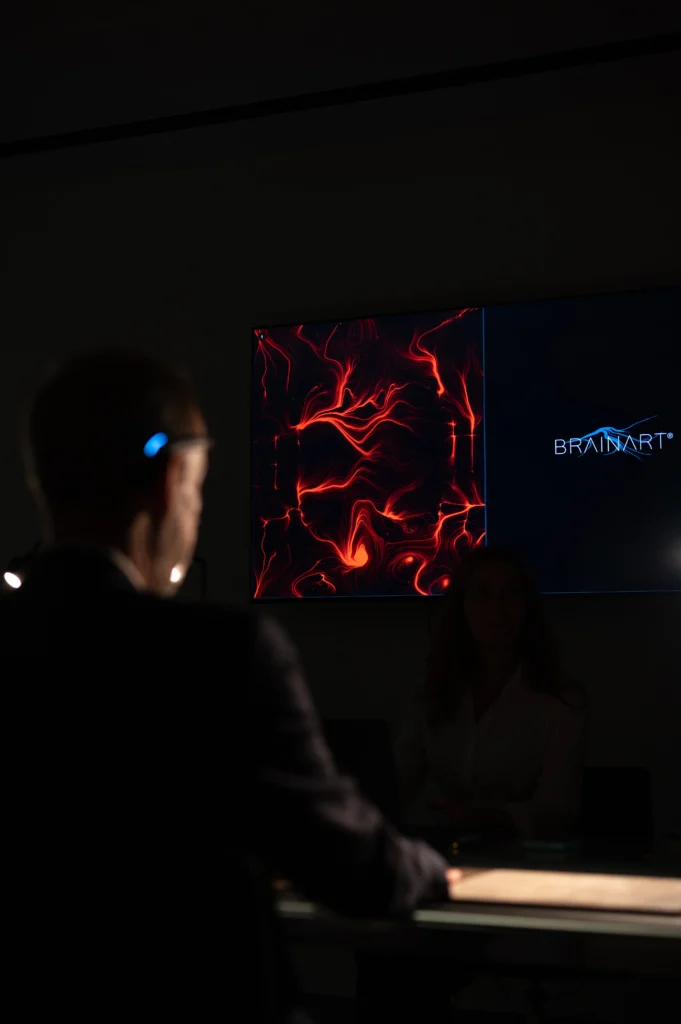
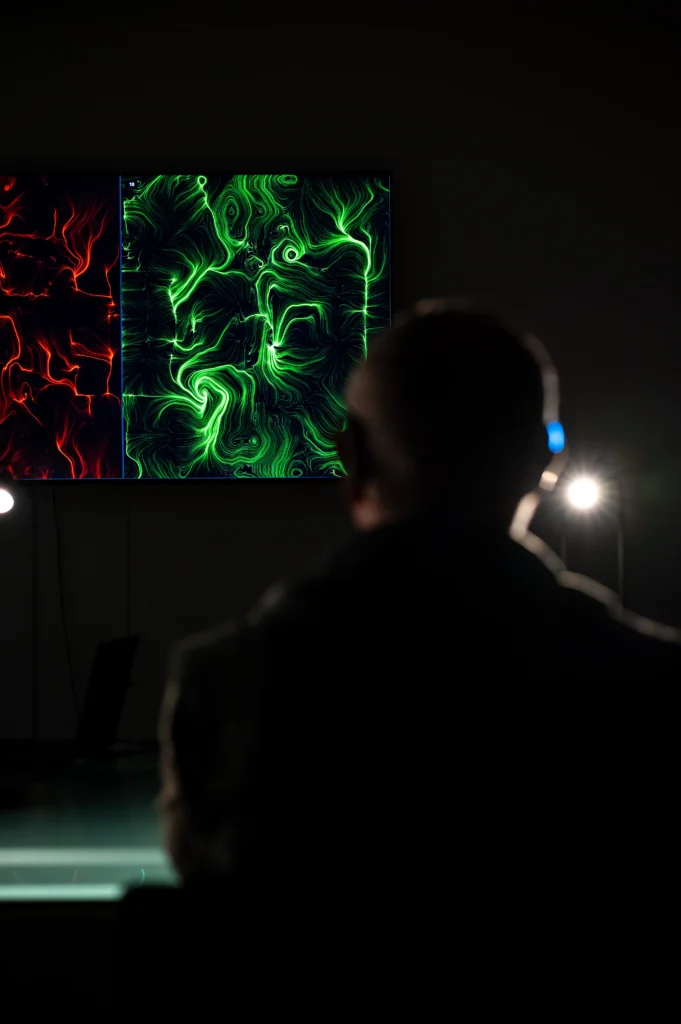
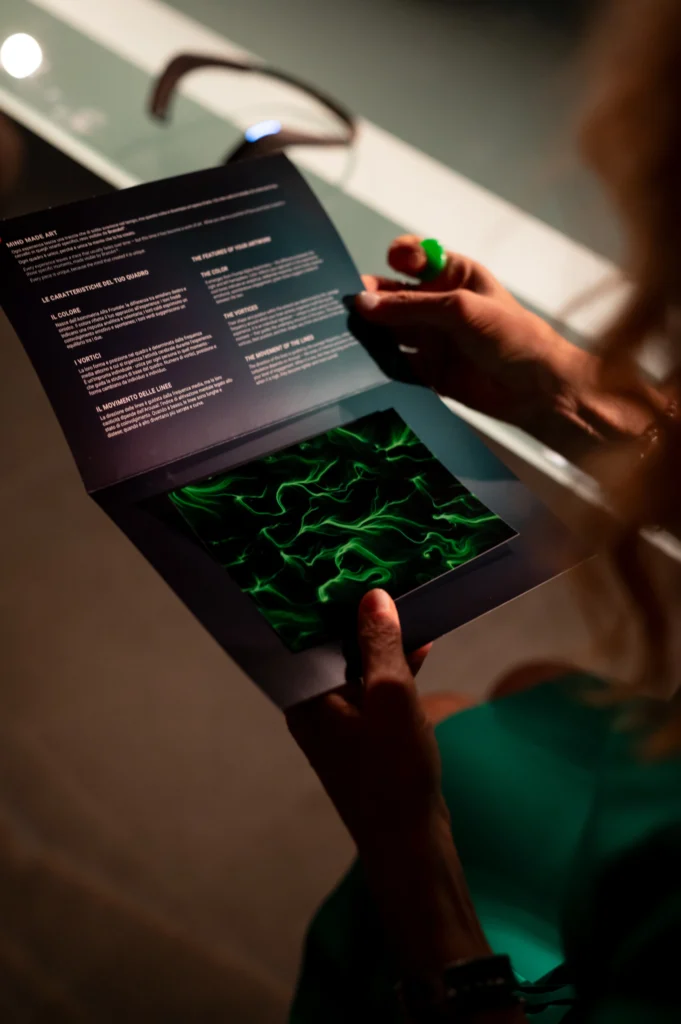
Traditional neuromarketing works in the laboratory. The person knows they are being observed, wears an EEG cap with many electrodes, an eye tracker and sensors for skin conductance, and performs a task in a controlled environment. The result is dozens of precise metrics, but collected in conditions very far from those in which consumers actually encounter a product. A shelf test carried out in an empty supermarket ignores the presence of other shoppers. The same test in a crowded supermarket makes the person uncomfortable, because they walk between the shelves with conspicuous equipment on their head. In both cases, the validity of the data suffers.
Our approach starts from the result the company wants to achieve and chooses the most suitable tool to measure it in real-world conditions. We collect less data than a laboratory, a few targeted metrics instead of fifty, but we collect them while the person is living an experience, without the burden of knowing they are being tested. This is the principle behind neuromarketing tests conducted outside the laboratory, and it involves a trade-off we always declare: less data, collected in a real situation. The tool also changes depending on the question. For example, to study product placement on a shelf, an EEG on the forehead would make little sense, and a system of cameras distributed throughout the space would provide more useful answers.
The Altadia study shows how BrainArt Product Lab works, our experiential neuromarketing format, in this case applied to tactile neuromarketing. Guests experience it as a moment of the event, and the company takes home a result it did not have before: measured evidence of how its audience’s brain responds to the product. It is data that can be used in communication, in the design of exhibition spaces and in development choices, obtained within an event the company would have organised anyway. The rigour remains that of a study, with a protocol defined in advance, exclusion criteria set before the analysis, and robustness checks.
The format adapts to any occasion in which a company puts a product into people’s hands: an inauguration like the one in Sassuolo, a launch in front of journalists and influencers, a showroom, the presentation of a new collection. At each of these events where we bring our experiences, the starting question is built together with the company, and it is that question that determines the protocol, the part of the body involved, the duration of the phases and the measurements to be collected.

Domande frequenti
Tactile neuromarketing studies how the brain responds to physical contact with a product or material, recording brain activity rather than relying solely on what the person reports. It is used to understand whether a surface, a texture or a packaging captures attention implicitly, before any conscious judgement about the product.
The study showed that contact with Altadia ceramic surfaces increases brain engagement by an average of 4.5% compared to rest. The increase was observed in 60% of participants, all of them customers and partners from the ceramics industry, people who are used to touching surfaces every day as part of their work.
No. Activation indicates that the material did not go unnoticed and that the brain is taking it into consideration, but the purchasing decision also depends on price, personal taste and context. It is the first step a product must pass, and a dedicated study can also measure liking.
Brain activity is recorded with a wearable headband, first during a moment of rest and then during contact with the surface. The two phases are compared for each participant, looking at the brain rhythms that increase when the brain is attentive and alert, and an engagement index is derived from them.
Yes, as long as the protocol is designed around the company’s question and the context of the event. With a dry wearable EEG, a session lasts about one minute, guests experience it as a moment of the evening, and the company receives a result measured in real-world conditions rather than in a laboratory.


Rendi unico il tuo evento con BrainArt®!